
Haymarket concrete care
Haymarket Driveway Red Clay Stains: Cleaning Without Etching
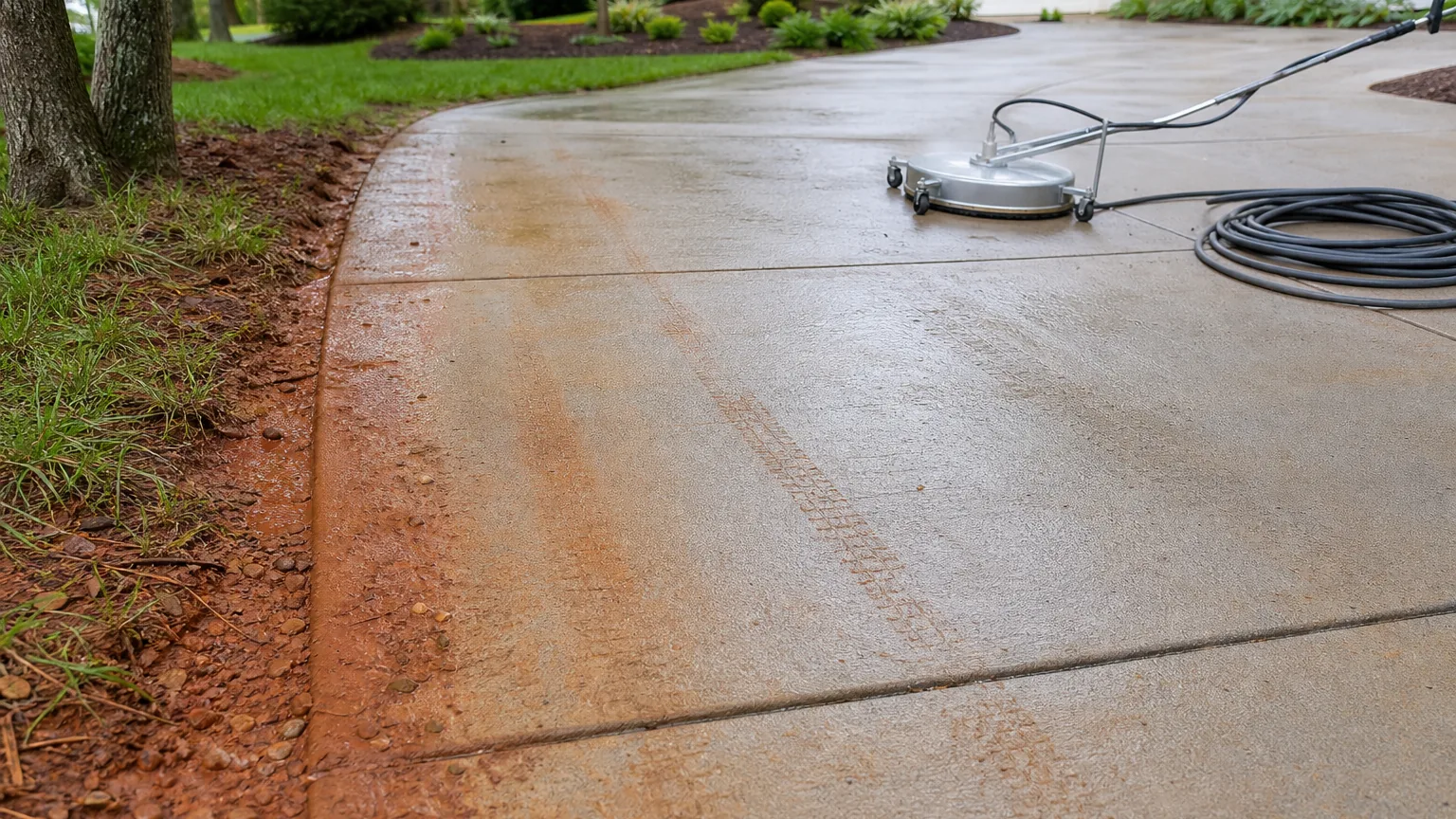
Haymarket driveway red clay stains form when fine soil particles wash or track onto damp concrete and settle into its broom-finished texture, pores, and control joints. Even pressure and an appropriate pre-treatment can lift superficial residue, but rust, oil, curing defects, and permanent discoloration require different solutions.
Red clay is easy to misidentify as rust or permanent concrete color. Diamond Power Washers can test the stain and the slab before choosing the cleaning process.
TL;DR
Start by identifying the stain. Loose clay, embedded clay, rust, oil, and concrete discoloration do not respond to one cleaner. Use a test area, apply even treatment, and avoid a narrow pressure tip that cuts clean lines into the slab. Cleaning improves contamination; it cannot repair etched or failing concrete.
Key takeaways
- Red soil at the lawn edge can repeatedly re-stain a clean driveway until drainage and tracking are addressed.
- A surface cleaner produces more even results than writing lines with a pressure-washing wand.
- Rust-colored staining may be clay, fertilizer, irrigation minerals, metal runoff, or actual rust.
- New or damaged concrete requires extra caution; cleaning is not resurfacing.
- The existing Haymarket driveway cleaning page remains the service and quote destination.
Why does red clay hold onto concrete?
Fine clay particles are small enough to pack into concrete’s textured surface and low spots. Tires and foot traffic press damp sediment into the slab, while runoff leaves concentrated bands along edges and joints. Once the water evaporates, the remaining mineral-rich residue can look deeper than ordinary dirt.
Haymarket properties often place driveways beside active landscaping, construction areas, or exposed soil. After rain, clay moves from beds and shoulders onto the slab. The most common pattern is not a uniform orange driveway; it is a darker edge, fan-shaped runoff mark, tire path, or stain where a downspout crosses concrete.
That pattern helps diagnose the source. A line below a metal railing may be rust. Small orange dots near lawn edges may come from fertilizer. A broad muddy band after rain is more likely soil transfer. Cleaning works better when the source and stain type are separated first.
What removes clay without damaging the slab?
Superficial clay usually responds to debris removal, suitable pre-treatment, controlled dwell time, and an even surface-cleaner pass followed by a thorough rinse. The operator should match pressure, flow, nozzle distance, and chemistry to the concrete condition. More pressure is not automatically more effective.
A rotary surface cleaner keeps the nozzles at a consistent height and spreads the work across an even path. That reduces the striped “zebra” pattern created when a wand moves too slowly or overlaps unevenly. Edges and joints still need controlled detail work because the machine cannot safely reach every corner.
Chemistry is stain-specific. A general concrete cleaner may release soil and organic film, while mineral or rust stains can require a different product. Randomly adding a strong acid is risky: it can change the surface texture, expose aggregate, react with metal, harm nearby plants, and leave a brighter patch that is more visible than the original stain.
What will driveway cleaning not fix?
Driveway cleaning will not close structural cracks, restore eroded paste, reverse salt scaling, repair pop-outs, or make mismatched concrete pours become one color. It can reveal the true slab condition after contamination is removed. Repairs, sealing, and resurfacing are separate decisions made after the concrete is clean and dry.
| What you see | Likely next step |
|---|---|
| Loose soil and tire transfer | Pre-treat, surface clean, rinse, correct tracking source |
| Orange line below metal | Test for rust; use a purpose-made treatment if confirmed |
| Dark oil spot | Degreasing and extraction; complete removal is not guaranteed |
| White powder or crust | Identify possible efflorescence before using chemistry |
| Flaking or exposed aggregate | Pause aggressive cleaning and evaluate the slab condition |
Freeze-thaw cycles can make existing defects more visible, especially where water enters cracks and joints. Cleaning does not create sound concrete, but an overly aggressive pass can worsen a fragile surface. That is why the inspection should happen before the equipment is started.
Should the driveway be sealed after cleaning?
Sealing can reduce water and contaminant absorption when the product fits the concrete, but it is not automatically required after every cleaning. The slab must be sound, clean, and adequately dry. Existing sealer, moisture movement, surface profile, and the new product’s instructions all affect the decision.
A clear sealer will not hide cracks or fix uneven color. Some products deepen the appearance; others remain nearly invisible. The wrong sealer or poor surface preparation can trap moisture, turn cloudy, peel, or become slippery. Treat cleaning and sealing as separate scopes with separate acceptance criteria.
How can you slow red-clay staining after cleaning?
Reduce repeat staining by keeping exposed soil below the concrete edge, directing downspouts away from the driveway, stabilizing bare areas, and removing muddy tire or foot traffic before it dries. Cleaning the slab without correcting the clay source often produces a short-lived result after the next heavy rain.
Simple changes help: refresh washed-out mulch, repair a low edge that channels water, add a stable stepping surface near garden beds, and avoid blowing loose soil onto damp concrete. These measures do not eliminate Northern Virginia weather, but they reduce the amount of sediment that reaches the slab.
Frequently asked questions
Is every orange driveway stain red clay?
No. Orange or brown staining can come from soil, rusting metal, fertilizer, irrigation water, leaves, or concrete materials. Location and pattern provide clues, but a small test is safer than assuming. Stain-specific treatment prevents unnecessary acid or pressure from changing the slab.
Can pressure washing etch a concrete driveway?
Yes. A narrow tip, excessive pressure, short working distance, or slow wand movement can remove surface paste and leave permanent lines. New, weak, already-scaled, or decorative concrete is more vulnerable. An even surface-cleaner pass and a test area reduce the risk.
Will driveway cleaning remove oil?
Fresh oil can often be reduced with absorbent material and a suitable degreaser. Older oil may migrate into the concrete pores and leave a shadow after treatment. Clay cleaning and oil removal are different processes, so tell the contractor about both before the estimate.
How long should concrete dry before sealing?
The correct drying period comes from the sealer manufacturer and current weather, not one universal number. Temperature, humidity, slab porosity, shade, and recent rain all matter. Applying sealer over trapped moisture can cause cloudiness, poor bond, or premature failure.
Should new concrete be pressure washed?
New concrete needs time to cure and develop strength before aggressive cleaning. The acceptable method depends on its age, mix, finish, and condition. If construction residue must be removed, confirm the concrete contractor’s guidance and use the least aggressive effective approach.
Clean the stain, not the surface paste
Diamond Power Washers provides controlled driveway cleaning in Haymarket and explains stain limitations before work begins.