
Concrete surface problems explained
What Is Efflorescence on Concrete, and Can Pressure Washing Fix It?
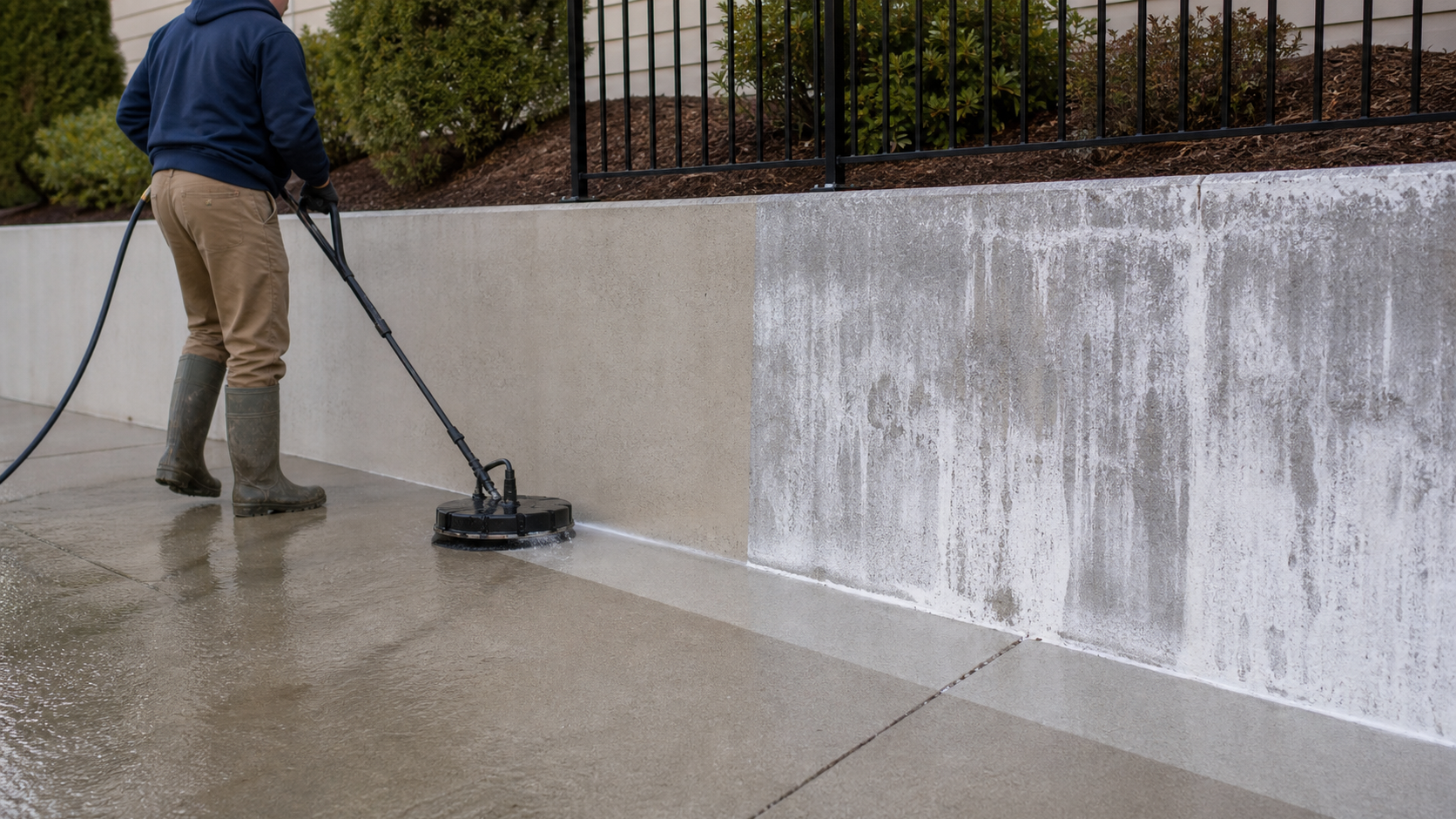
Efflorescence is the white, chalky, salt-like residue that forms on concrete when water moves through the slab and carries dissolved minerals to the surface. As the water evaporates, the minerals are left behind as a powdery or crusty deposit. Pressure washing removes fresh, light efflorescence effectively. Thick or deeply bonded deposits need an acid wash or professional efflorescence cleaner first, followed by pressure washing to rinse and neutralize. Pressure washing alone won’t stop it from returning if the underlying moisture source isn’t addressed.
What Efflorescence Actually Is
Concrete is porous. When water enters the slab from below — through the soil, from precipitation, or from irrigation — it dissolves calcium hydroxide and other soluble salts that are part of the concrete’s cement chemistry. That water migrates upward through the slab’s capillary network and reaches the surface. When it evaporates, the dissolved minerals stay behind. That residue is efflorescence.
The word comes from the French “effleurer” — to blossom. That’s a generous description for something that looks like a concrete driveway dusted with dried salt or painted over with diluted white paint. In practice, it looks like one of three things:
- A powdery, chalky white film on the surface — usually secondary efflorescence that forms after the initial cure
- White streaks or haze that follows water drainage paths — common along expansion joints and low spots
- Crystalline, crusted deposits — these are older and more bonded, often seen on brick and block as well as concrete
It’s not structurally harmful in most cases. Efflorescence is a cosmetic problem first and a diagnostic indicator second. When a fresh concrete driveway develops white haze in the first season, it’s normal: the cement is still curing and releasing moisture. When an older slab develops heavy efflorescence in a specific area, that usually points to a drainage issue or a crack that’s letting water in from below.
Where It Shows Up Most Often in Northern Virginia
In Northern Virginia, efflorescence is most common on driveways, concrete patios, retaining walls, and brick or block foundations. The wet winters and freeze-thaw cycles accelerate mineral migration through any porous masonry surface.
Spring is peak season for efflorescence calls. After months of snow melt and rain pushing water through concrete, homeowners see the white residue once the surface dries and warms. Retaining walls and concrete block foundations in Fairfax, Manassas, and Woodbridge are particularly prone because they’re in constant contact with soil moisture on one face.
Can Pressure Washing Remove Efflorescence?
That depends on how old the deposit is and how thickly it’s bonded to the surface.
| Efflorescence type | Appearance | Pressure washing result |
|---|---|---|
| Fresh / light (0–6 months) | Powdery white haze, brushes off easily | Removed effectively with 2,500–3,000 PSI and a surface cleaner |
| Moderate (6–18 months) | Thicker deposit, slightly crusted | Mostly removed; some staining may remain; diluted acid wash recommended first |
| Heavy / old (18+ months) | Hard, crusty layer, often grayish-white | Pressure washing alone insufficient; acid or efflorescence cleaner required before wash |
| Secondary deposits on brick or block | White streaks following mortar joints | Partially removed; joints may need repointing to stop recurrence |
For fresh, powdery deposits on a concrete driveway or patio, pressure washing at 2,500 to 3,000 PSI with a surface cleaner attachment will clear most of it. The surface cleaner distributes pressure evenly without the tiger-striping that a wand can leave on concrete. A slight detergent application before the wash helps lift the mineral layer.
For older, bonded deposits, a professional efflorescence remover — typically a diluted phosphoric or muriatic acid solution, applied, dwelled, and scrubbed — breaks the bond before the pressure wash rinse. Acid treatments require careful neutralization after application, and the runoff has to be managed so it doesn’t contact plants, grass, or painted surfaces. This is not a DIY-friendly process for heavy deposits.
Will Pressure Washing Stop Efflorescence from Coming Back?
No. Pressure washing treats the surface deposit. It doesn’t address the water moving through the concrete. If the moisture source continues, efflorescence will re-form.
The long-term fix addresses the moisture source, not the symptom:
- Improve drainage so water doesn’t pool against the slab or retaining wall
- Repair cracks that let water enter from below
- Apply a penetrating concrete sealer after washing — this slows capillary movement significantly
- For retaining walls and foundations, waterproofing the back face (soil side) is the most effective long-term solution
- Keep irrigation heads from spraying directly onto concrete surfaces
A penetrating silane-siloxane sealer, applied after a thorough wash and full dry (at least 48 hours), is the most practical post-wash step for a homeowner dealing with a driveway or patio. It doesn’t stop moisture from moving through the slab entirely, but it significantly slows the capillary action that carries dissolved salts to the surface.
Efflorescence vs. Other White Stains
Not every white stain on concrete is efflorescence. A few other things can look similar:
Paint or sealer residue, calcium deposits from hard water (sprinkler heads), lime run-off from adjacent masonry, and salt staining from de-icers can all appear as white or grayish-white deposits. They respond differently to treatment, so correct identification matters before applying any chemical.
| Stain type | How to tell it apart | Treatment approach |
|---|---|---|
| Efflorescence | Powdery, follows water paths, often appears after wet weather | Acid wash + pressure rinse + sealer |
| Calcium / hard water deposits | Near sprinkler spray zones, hard crusty rings | Calcium lime remover + pressure wash |
| De-icer salt staining | Appears in winter; fades by mid-spring with rain | Pressure wash in spring; apply sealer before winter |
| Paint / sealer residue | Peeling edges, color variation, follows application pattern | Surface cleaner at high PSI; paint stripper for thick coats |
| Lime run-off from mortar | Streaks from above (steps, coping, ledger); whitens in rain | Diluted acid cleaner; pressure wash rinse |
When in doubt, a simple test: wet the deposit. Efflorescence often darkens and becomes translucent when wet, then reappears as the surface dries. Hard water calcium deposits don’t behave the same way. If the stain dissolves partially under water and returns fully once dry, you’re dealing with efflorescence.
Licensed & insured. Veteran-owned. Serving Fairfax, Manassas, Woodbridge, and 15+ cities across Northern Virginia.
What Diamond Does for Efflorescence Jobs
When a Northern Virginia homeowner calls about white deposits on a driveway or patio, Diamond’s process depends on the deposit’s age and extent:
- Walk the surface and assess deposit thickness and bond strength
- For light deposits: apply a pre-treatment detergent, then wash at 2,500–3,000 PSI with a surface cleaner
- For moderate to heavy deposits: discuss a two-step process — chemical treatment followed by pressure rinse — including what the chemical treatment costs and what to expect
- Rinse thoroughly to remove all chemical residue; neutralize if acid was used
- Walk the surface after it’s dry to confirm results and note any remaining spots
Diamond does not apply sealers — that’s a separate service category — but we’ll point you toward timing: wait at least 48 hours after washing before any sealer goes down, and check moisture content with a plastic sheet test if you’re unsure whether the concrete is dry enough.
For related concrete surface issues like oil staining from driveways, see: how to remove oil stains from a concrete driveway.
White Residue on Your Concrete?
Diamond Power Washers handles efflorescence, hard water stains, and general concrete cleaning across Northern Virginia. Call or get an instant quote online.
Frequently Asked Questions
Is efflorescence harmful to concrete?
In most cases, no. Efflorescence is a cosmetic issue that doesn’t weaken the concrete itself. However, heavy or persistent efflorescence on retaining walls, foundations, or block walls can indicate ongoing moisture intrusion that, over time, can contribute to freeze-thaw damage in Northern Virginia’s climate. Address the moisture source before or alongside treating the surface deposit.
How much PSI do you need to remove efflorescence from a concrete driveway?
For fresh, powdery deposits on standard concrete, 2,500 to 3,000 PSI with a surface cleaner attachment is effective. Using a narrow-angle wand at high PSI can etch the concrete surface and should be avoided. For thicker, bonded deposits, chemical pre-treatment does most of the work; the pressure wash rinses rather than blasts the deposit loose.
Can I remove efflorescence myself with a garden hose or scrub brush?
A scrub brush and water can remove the lightest, freshest deposits. Garden hose pressure is too low to do much on anything thicker than a surface dust. For anything beyond a recent light haze, you’ll need either a pressure washer or a chemical efflorescence remover (phosphoric acid-based). If you’re using acid-based cleaners, follow manufacturer safety instructions and neutralize thoroughly — acid left in concrete pores can cause secondary damage.
Does sealing concrete after washing prevent efflorescence from coming back?
A penetrating silane-siloxane sealer significantly slows capillary moisture movement through the slab, which reduces how quickly efflorescence re-forms. It doesn’t eliminate it entirely if the underlying moisture source is active. Sealing is most effective when combined with improved drainage. Film-forming sealers (acrylic, epoxy) can actually trap moisture and worsen efflorescence; penetrating sealers are the right choice for this problem.
Why does my concrete get efflorescence every spring?
Seasonal efflorescence is very common in Northern Virginia. Winter moisture — rain, snow melt — saturates the soil under and around the slab. As the ground freezes and thaws repeatedly, that moisture moves through the concrete. When spring warmth arrives and the surface starts to dry, the dissolved salts appear as white deposits. Improving drainage around the slab, sealing the concrete in fall, and keeping the area around expansion joints clear of soil buildup all help reduce the spring cycle.
Is white staining on my concrete always efflorescence?
Not necessarily. Hard water deposits from irrigation, de-icer salt residue, lime run-off from adjacent mortar, and paint or sealer residue can all appear as white or whitish staining. The easiest field test: wet the stain. Efflorescence typically appears semi-transparent when wet and reappears as white powder when dry. Hard water calcium deposits are rough and crusty and don’t behave the same way.
How soon after a new concrete pour does efflorescence appear?
It’s common to see light efflorescence in the first three to six months after a new pour. This is called primary efflorescence and results from the cement’s own curing chemistry releasing calcium hydroxide as moisture migrates out of the slab. It typically fades or disappears on its own as the concrete finishes curing, often within the first year. Persistent or heavy deposits after the first year point to an ongoing moisture source rather than normal curing.
Can Diamond handle efflorescence on brick and retaining walls, not just concrete?
Yes. Efflorescence appears on brick, concrete block, and poured concrete alike — the mineral migration process is the same. Retaining wall faces in Northern Virginia are some of the highest-efflorescence surfaces we see, because they’re in constant contact with soil moisture on the back side. Treatment approach is similar: assess deposit thickness, apply appropriate cleaner if needed, pressure wash, and discuss drainage improvements with the homeowner.
About this page: Diamond Power Washers is a veteran-owned, family-operated pressure washing company serving Northern Virginia since 2017. Our crews handle concrete driveways, patios, retaining walls, and masonry surfaces throughout Fairfax, Manassas, Woodbridge, and surrounding communities. This page provides general guidance on efflorescence and is not a substitute for on-site assessment by a qualified contractor. Licensed & fully insured in Virginia.