
Fiber cement siding cleaning
Can You Pressure Wash Hardie Board Siding?
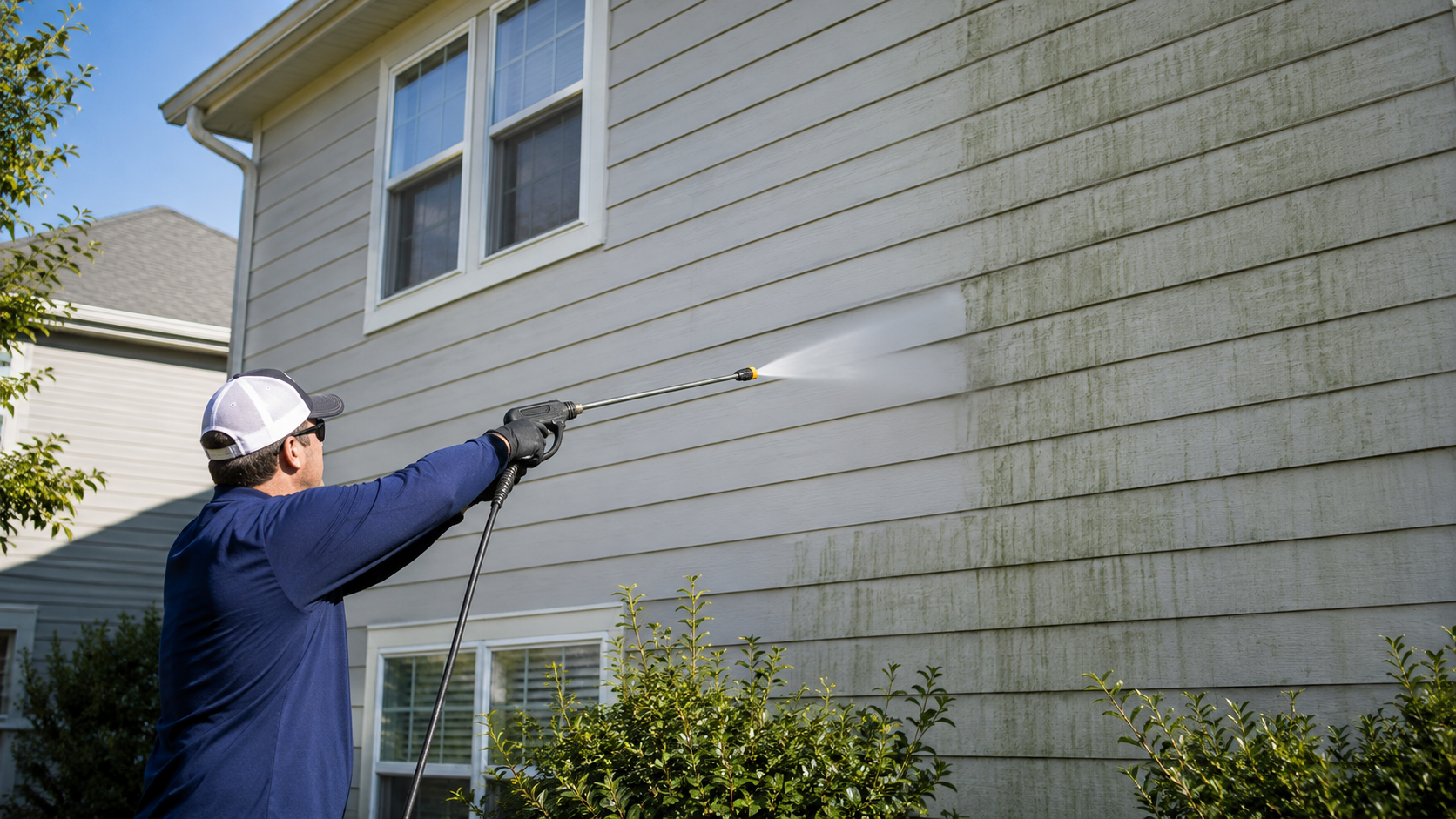
Yes, you can pressure wash Hardie board (fiber cement) siding, but the technique matters. James Hardie recommends using a garden hose or low-pressure washer — no more than 1,500 PSI — with a fan-tip nozzle held at least 6 inches from the surface. Angling the spray downward and keeping the wand moving prevents water from forcing behind laps, lifting paint, or penetrating around trim joints. A professional with the right equipment and experience gets the siding clean without voiding your warranty or causing moisture damage.
What Makes Hardie Board Different from Other Siding
Hardie board is fiber cement: a composite of Portland cement, sand, and cellulose fiber. It’s denser and heavier than vinyl, but it’s also more absorbent. Water forced behind the laps or into exposed end cuts can swell the fiber content and lead to paint failure and rot — which is the core reason the cleaning approach differs from vinyl.
James Hardie products dominate new construction in Northern Virginia. The homes going up in Gainesville, Ashburn, and Chantilly’s newer communities are full of it. That’s partly because fiber cement holds paint better than wood, resists termites, and doesn’t buckle in the heat the way vinyl can. But it has one key vulnerability: moisture infiltration at the laps, end cuts, and trim joints.
Unlike vinyl siding, which is essentially waterproof and lets water shed off it freely, Hardie board is porous. The factory-applied paint coating protects it when the surface is intact, but high-pressure washing can blast water under the laps, chip the finish, or drive moisture into any gap around windows, doors, or penetrations. Once water is in, you get swelling, paint bubbling, and eventually rot at end cuts — which the manufacturer’s warranty explicitly excludes damage from improper cleaning.
What Northern Virginia’s Climate Does to Fiber Cement
Our mid-Atlantic climate gives Hardie board a particular challenge. Northern Virginia homes go through real freeze-thaw cycles, humid summers with pollen, and spring periods with heavy biological growth on north-facing walls. The result: fiber cement siding that looks grimy within two to three years on north and shaded elevations. Green algae along the lap edges, pollen haze across the lower panels, and mildew on the trim are common complaints from homeowners in Fairfax and Manassas.
The biology grows on the surface coating, not in the fiber itself — which means soft washing removes it cleanly without needing to blast the surface. The challenge is that homeowners sometimes attempt pressure washing at rental-equipment PSI levels (3,000 PSI or more), which is far beyond what the siding can tolerate safely.
The Right Way to Clean Fiber Cement Siding
James Hardie’s published cleaning guidelines are specific. The key rules:
- Maximum 1,500 PSI — anything above this risks chipping the paint finish and forcing water behind laps
- Fan tip, not a zero-degree tip — concentrated streams can score the surface; a 25-40 degree fan tip distributes pressure safely
- Angle downward, not upward — spraying upward forces water under the lap joints; always spray with the lap, not against it
- Stay at least 6 inches from the surface — closer than that concentrates pressure regardless of PSI setting
- Keep the wand moving — dwelling on one spot concentrates impact and heat from friction
For biological growth — algae, mildew, mold spots — a low-concentration bleach-and-water solution applied first, dwelled for a few minutes, then rinsed at low pressure removes the growth cleanly. This is essentially a soft-wash approach on a surface that most people think of as hard enough to blast.
| Siding type | Safe PSI range | Key risk to avoid |
|---|---|---|
| Hardie board / fiber cement | 800–1,500 PSI | Water behind laps, paint chipping, end-cut swelling |
| Vinyl siding | 1,200–2,000 PSI | Forcing water behind panels, cracking at low temps |
| Brick | 1,500–2,500 PSI | Mortar erosion at close range, spalling on old brick |
| Stucco / EIFS | Under 1,000 PSI | Surface delamination, water intrusion at cracks |
| Wood / cedar shake | 500–1,200 PSI | Grain raising, splintering, premature weathering |
What Happens When Hardie Board Is Cleaned Incorrectly
High-pressure washing can chip the paint finish on fiber cement siding, force water behind the lap joints where it can’t drain, and drive moisture into end cuts that weren’t properly caulked. The result: paint bubbling, joint swelling, and eventually exposed fiber that soaks up moisture and breaks down. These repairs are expensive and are not covered by the product warranty.
We see this in Fairfax County fairly regularly — a homeowner rented a pressure washer, set it to full power, and tried to clean algae off their Hardie-sided house. The siding looks clean right after, but within weeks, paint starts bubbling at the lap edges. By fall, some of those laps are visibly swollen. The homeowner calls a contractor expecting a warranty claim and finds out that improper cleaning voided the coverage.
The other common mistake is cleaning upward. Hardie board laps like any horizontal siding: the upper panel overlaps the lower one so water sheds downward and out. Spraying upward drives water right into the gap where that overlap happens. There’s no caulk there — the gap is the drainage path. Water that goes in upward has nowhere to go except into the wall assembly.
Cleaning Products Safe for Fiber Cement
James Hardie recommends mild detergent cleaners for routine maintenance. For biological growth, a diluted solution of household bleach (no more than 1 part bleach to 3 parts water) applied with a soft-bristle brush or low-pressure spray, then rinsed thoroughly, is the standard approach. Products that are safe for painted surfaces generally work well on fiber cement.
- Avoid high-alkaline cleaners — they can affect the paint finish and the cement binder over time
- Avoid degreasers not formulated for painted surfaces — they can soften and cloud the paint sheen
- Avoid acid washes — appropriate for bare concrete but damaging to fiber cement’s alkaline chemistry
- Avoid anything abrasive — the paint coating is the surface protection; scratching it exposes the fiber layer underneath
How Often Should You Clean Hardie Board Siding
James Hardie’s maintenance guidelines suggest cleaning as needed, which in practice means every one to two years for most Northern Virginia homes. North-facing walls in shaded lots, especially in tree-heavy communities like Reston and the wooded parts of Fairfax, tend to grow algae faster. Annual cleaning keeps the growth from embedding in the paint surface and makes each wash easier.
For homes near mulch beds, artillery fungus is a separate concern. The tiny black spots from mulch-dwelling Sphaerobolus fungus adhere firmly to the paint surface and need a targeted treatment approach. They’re more common on white and light-gray Hardie homes that back up to mulched landscaping. See our guide on removing artillery fungus from siding if that’s what you’re dealing with.
Hardie Board Siding Cleaning Across Northern Virginia
Diamond Power Washers cleans fiber cement siding the right way: low-pressure, downward angle, surface-safe detergent. Veteran-owned. Licensed & fully insured in Virginia. Serving Fairfax, Manassas, Woodbridge, Chantilly, Ashburn, and 15+ communities.
Frequently Asked Questions
Does pressure washing Hardie board void the warranty?
It can. James Hardie’s warranty requires that cleaning follow their published guidelines: no more than 1,500 PSI, fan-tip nozzle, downward angle, at least 6 inches from the surface. Cleaning above those limits can void coverage for paint and product defects. This is why hiring a professional who knows fiber cement siding cleaning procedures matters more for Hardie homes than it might for vinyl.
What PSI is safe for pressure washing Hardie board?
James Hardie’s own guidelines recommend no more than 1,500 PSI, and many professionals clean fiber cement at 800 to 1,200 PSI for routine maintenance. The real risk isn’t just PSI — it’s also nozzle angle and distance. A 1,500 PSI spray held 3 inches from the surface with a zero-degree tip is more damaging than 2,000 PSI held 12 inches away with a 40-degree fan tip.
Can soft washing damage Hardie board?
Soft washing — low pressure plus a bleach-based biocide solution — is actually the safest approach for fiber cement siding. The chemical does the work of killing and releasing algae and mildew; the rinse pressure is low enough to pose no risk to the paint or laps. It’s the preferred method for biological growth on Hardie board. The detergent dilutions used professionally are safe for painted surfaces.
How do you get green algae off Hardie board siding?
A diluted bleach solution (1 part bleach, 3 parts water) applied with a low-pressure spray or soft brush, dwelled for 5 to 10 minutes, then rinsed thoroughly at low pressure removes algae from fiber cement effectively. The bleach kills the organism at the root rather than just rinsing it off the surface, so results last longer. Never scrub aggressively — it risks scratching the paint finish.
Can I pressure wash my Hardie board siding myself?
Technically yes, if you follow the manufacturer guidelines: stay under 1,500 PSI, use a fan tip, spray downward, keep the wand moving, and stay at least 6 inches from the surface. The risk is that consumer-grade pressure washers often lack fine PSI control, and rental units at 3,000 PSI are genuinely dangerous for fiber cement. Many homeowners also naturally spray upward when reaching higher panels, which forces water behind the laps. A professional eliminates those risk factors.
How often does Hardie board siding need to be cleaned?
James Hardie recommends cleaning as needed — typically every one to two years in most climates. In Northern Virginia, north-facing walls in shaded or wooded lots may need cleaning annually because the combination of shade, humidity, and pollen creates ideal conditions for algae. South-facing walls with good sun exposure tend to stay cleaner longer. A yearly walkthrough to check for early biological growth is a good maintenance habit.
What cleaning products should I avoid on Hardie board?
Avoid acid-based cleaners, highly alkaline degreasers, abrasive scrubs, and solvents. These can affect the paint finish or the cement binder. Mild dish soap, diluted bleach (for algae and mildew), and detergents specifically formulated for painted exterior surfaces are all appropriate. When in doubt, James Hardie’s website lists approved cleaning products for their specific paint finishes.
Is Hardie board harder to clean than vinyl siding?
More nuanced, not necessarily harder. Vinyl is more forgiving of pressure because it sheds water naturally and doesn’t absorb it. Hardie board needs a more careful technique to avoid pushing water behind the laps or damaging the paint. For biological growth, the same low-pressure chemical approach works on both. The difference is that errors in technique matter more with fiber cement than vinyl.
Written by the Diamond Power Washers team. Veteran-owned, family-owned, licensed & fully insured in Virginia. We’ve cleaned fiber cement siding on homes throughout Fairfax, Manassas, Woodbridge, and Northern Virginia’s newer communities where Hardie board is standard on new construction.
Last updated September 2026.
Sources: James Hardie Building Products cleaning and maintenance guidelines; field experience cleaning fiber cement siding in Northern Virginia’s mid-Atlantic climate.
or call 703-853-4738