
Concrete surface cleaning
Can You Pressure Wash a Garage Floor?
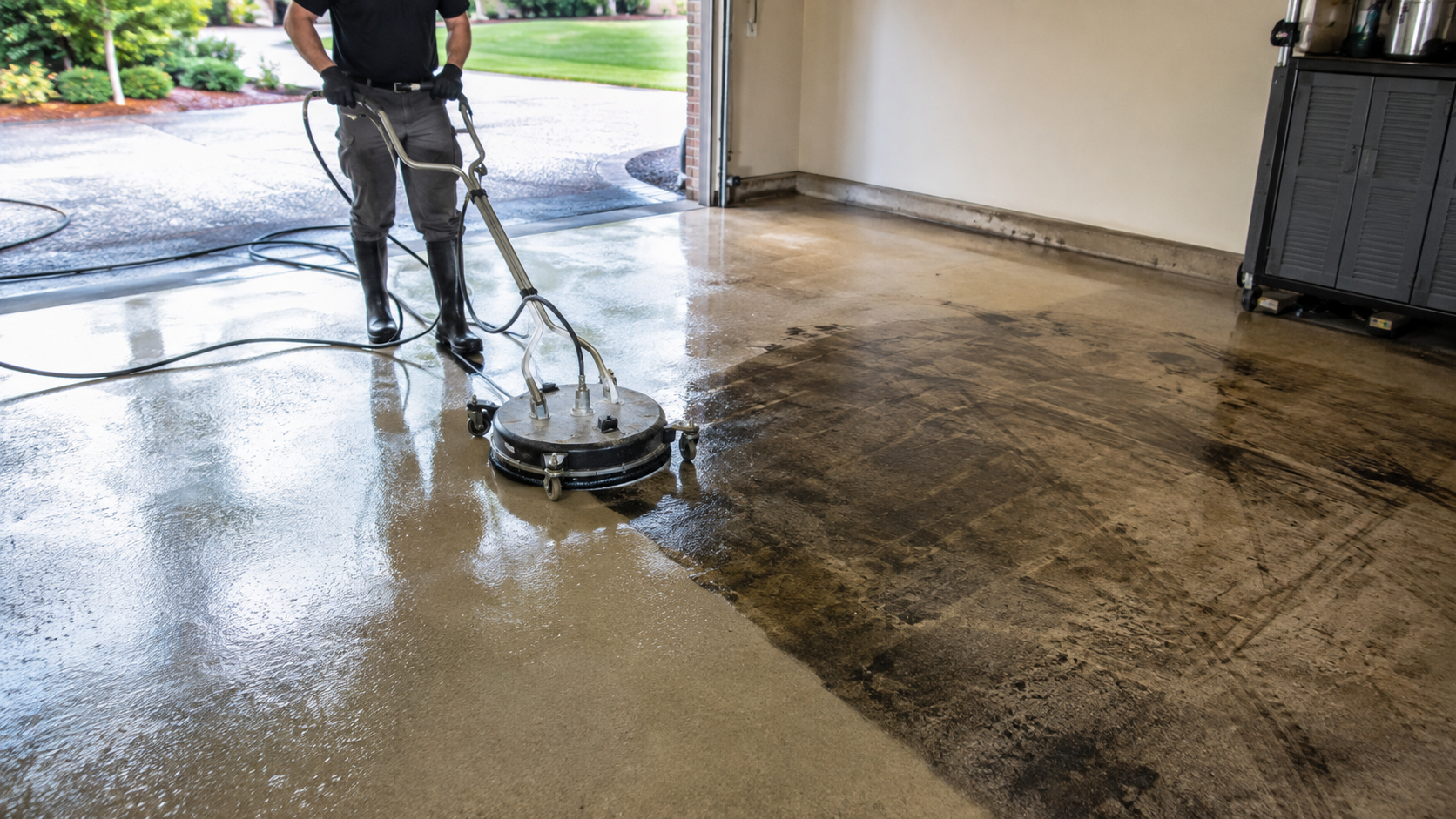
Yes. A garage floor is one of the most satisfying concrete surfaces to pressure wash. A surface cleaner attachment at 2,500 to 3,000 PSI removes years of accumulated dirt, oil drips, and tire marks in a single pass. The key considerations are drainage, oil stain pre-treatment, and whether the floor has a coating or sealer that could peel under high pressure. Done right, a garage floor wash takes about an hour and leaves the concrete looking close to new.
Why Garage Floors Get So Dirty
A garage floor collects motor oil drips, transmission fluid, road grime tracked in on tires, leaf debris, and in Northern Virginia’s winters, road salt and ice-melt residue. The concrete is usually bare or lightly sealed, which means all of that soaks in rather than sitting on the surface.
Most homeowners don’t clean their garage floor because it feels like the kind of mess that isn’t worth dealing with. But the buildup has real consequences. Oil and road salt both degrade bare concrete over time. Salt accelerates spalling and cracking. Oil penetrates the pores and eventually becomes almost impossible to lift without chemical help. The longer those stains sit, the harder they are to remove.
In Northern Virginia, road salt use from late November through early March means every car tracked into the garage brings chemical residue with it. That salt concentration, sitting wet on concrete through repeated freeze-thaw cycles, is one of the more damaging things a garage floor faces. An annual spring wash removes that residue before it does its worst.
What You’re Actually Dealing With
A typical garage floor in Fairfax or Manassas has a few distinct problem zones:
- Parking spots: tire-track embedded grime, oil drip patches directly below the engine bay, and salt residue along the edges
- Entry zone near the door: the heaviest mud, leaf debris, and moisture concentration from open doors in rain and snow
- Against the walls: stored items leave shadows; moisture condenses here and grows algae in older garages
- Expansion joints: dirt and debris pack into these gaps and can harbor mold in humid summers
None of these is particularly difficult for a pressure washer. The challenge is that a garage is an enclosed or semi-enclosed space, so water management matters more than it does on an open driveway.
The Right Approach for Garage Floor Pressure Washing
Here’s the sequence professionals use for a garage floor:
- Clear the garage — move cars, tools, boxes, and anything stored on the floor. Don’t try to wash around stuff.
- Pre-treat oil stains — apply a degreaser to any dark oil patches and let it dwell for 10 to 15 minutes before washing. Oil doesn’t lift under water pressure alone; the degreaser breaks the bond first. See our page on removing oil stains from concrete for more detail on the process.
- Sweep out loose debris — remove leaf piles and large debris before washing; pressure washing them creates a sludge that’s harder to manage than dry debris
- Set up drainage — identify where water will exit. Most garages drain through the apron and down the driveway. If the floor slopes toward the back wall, you may need to squeegee water toward the door during the wash.
- Wash with a surface cleaner — a round surface cleaner attachment at 2,500 to 3,000 PSI produces an even clean without leaving wand stripes on the concrete. Work in overlapping passes from the back of the garage toward the door.
- Rinse once more — after the surface cleaner pass, a final rinse wand pass toward the door flushes remaining residue out.
- Let dry completely — 24 to 48 hours before parking again, especially if you’re planning to apply a sealer or coating afterward.
Bare Concrete vs. Sealed or Epoxy-Coated Floors
Bare concrete tolerates 2,500 to 3,000 PSI well. Epoxy-coated floors and floors with penetrating sealers need a gentler approach — too much pressure or a zero-degree tip can chip, delaminate, or scratch the coating. For epoxy-coated floors, 1,500 to 2,000 PSI with a fan tip and a no-wax-safe degreaser is a safer starting point.
Epoxy-coated garage floors are increasingly common in Fairfax and Ashburn communities where homeowners invest in finished spaces. The coating is durable but not indestructible. High-pressure washing with a zero-degree or 15-degree tip can chip the coating at edges and corners, especially where the coating is thinner or where it wasn’t properly bonded to the concrete during installation. A fan tip at moderate distance removes dirt without that risk.
| Floor type | Safe PSI range | Notes |
|---|---|---|
| Bare concrete (standard) | 2,500–3,000 PSI | Surface cleaner attachment recommended; degreaser pre-treat for oil spots |
| Penetrating sealer (silane/siloxane) | 2,000–2,500 PSI | Sealer is in the pores, not on the surface; standard wash is fine |
| Epoxy coating (2-part) | 1,500–2,000 PSI | Fan tip only; avoid zero/15-degree; no acid cleaners |
| Polyurea / polyaspartic coating | 1,500–2,000 PSI | Same as epoxy; check manufacturer spec before any chemical application |
| Painted concrete | 1,200–1,800 PSI | Paint can chip under high pressure; low-moderate with fan tip |
Drainage: The One Thing People Overlook
Pressure washing produces a significant volume of water in a short time. On a driveway, that’s fine — the water runs off naturally. In a garage, the water has to go somewhere specific. Most garage slabs slope slightly toward the door, which is the natural exit path. But not every garage was poured correctly, and not every homeowner knows their floor’s slope direction before starting.
Before washing, pour a small amount of water on the floor and watch where it goes. If it runs toward the door: you’re in good shape. If it pools in a low spot or runs toward the back wall: you’ll need to squeegee water toward the door as you work, or expect standing water at the back once you’re done.
Keep the garage door fully open during the wash. This improves drainage, provides ventilation for any chemical pre-treatment, and lets you direct water out cleanly. Never pressure wash a garage with the door partially closed — the spray has nowhere to go and soaks the walls and stored items.
What Pressure Washing a Garage Floor Won’t Fix
Pressure washing removes surface contamination. It doesn’t repair concrete or fix structural problems:
- Deep oil stains (years old): penetrated deep into pores; degreaser plus wash removes most, but some permanent staining may remain at the very surface
- Concrete spalling or pitting: freeze-thaw damage and road salt often cause the concrete surface to pop and pit; washing cleans it but doesn’t fill or repair those damaged areas
- Cracks: washing can clean debris from cracks but doesn’t close them; they need caulking or crack filler after washing
- Efflorescence from below: if white mineral deposits keep reappearing after washing, there’s a moisture source from below that needs to be addressed — see our page on efflorescence on concrete
Ready for a Clean Garage Floor?
Diamond Power Washers handles garage floors, driveways, and all concrete surfaces across Northern Virginia. Veteran-owned, licensed & insured. Serving Fairfax, Manassas, Woodbridge, Chantilly, and 15+ communities.
Frequently Asked Questions
How long does it take to pressure wash a two-car garage floor?
A standard two-car garage floor takes about 30 to 60 minutes to pressure wash, depending on how much pre-treatment oil stains need and how dirty the floor is overall. Clearing the garage, treating stains, washing, and squeegeeing the water out typically runs about 60 to 90 minutes total on-site. Drying takes 24 to 48 hours before the space is ready for normal use.
Can pressure washing remove old oil stains from a garage floor?
It depends on how old they are and how deeply they’ve penetrated. Fresh oil drips from the past year or two lift well with a degreaser pre-treatment followed by a high-pressure wash at 2,500 to 3,000 PSI. Oil that’s been soaking into the concrete for five or more years may leave a lighter shadow even after treatment — the top layers lift but the deep penetration remains. Multiple treatments over time can reduce older stains further.
Is it okay to pressure wash an epoxy-coated garage floor?
Yes, with the right settings. Use 1,500 to 2,000 PSI with a fan-tip nozzle, not a zero-degree or 15-degree tip. Stay at least 6 to 8 inches from the surface. Use a degreaser rated safe for coated surfaces — acidic or solvent-based cleaners can soften epoxy coatings. Avoid steam cleaning; high heat can affect epoxy adhesion and clarity.
What do I need to do before pressure washing my garage floor?
Move everything off the floor: cars, bikes, tools, boxes. Apply degreaser to any visible oil stains and let it dwell for 10 to 15 minutes. Sweep out loose debris. Make sure the garage door is fully open. Know where the water will drain — most floors slope toward the door, but check before you start so you’re not surprised by pooling water at the back of the garage.
How often should I pressure wash my garage floor?
Once a year is a good baseline for most Northern Virginia homeowners — ideally in late spring, after road salt season ends. This removes the winter’s worth of salt residue before it has a chance to degrade the concrete surface. If you notice heavy oil buildup or the floor looks visibly dark, cleaning twice a year (spring and fall) gives better results.
Do I need to seal my garage floor after pressure washing?
You don’t need to, but sealing after washing is an excellent time to do it because the surface is clean and pores are open. A penetrating concrete sealer slows future oil and salt penetration, making the next cleaning easier. If you’re going to apply any coating — epoxy, polyurea, or paint — pressure washing beforehand is actually required because coatings don’t adhere properly to dirty concrete.
Can I use bleach on a garage floor?
Diluted bleach (one part bleach to three or four parts water) is appropriate for killing mold or mildew growth on a concrete garage floor — which sometimes appears in humid summers in garages with poor ventilation. It’s not effective on oil stains and shouldn’t be used on freshly applied sealers or coatings. Rinse thoroughly after use; bleach residue left to dry on concrete can lighten the surface unevenly.
Will pressure washing remove road salt from my garage floor?
Yes. Road salt is water-soluble and lifts easily under pressure washing. A hot-water pressure washer is slightly more effective at dissolving heavy salt buildup, but a standard cold-water unit at 2,500 PSI with a thorough rinse removes seasonal salt accumulation effectively. The key is doing it annually in spring — before the salt has months of dry-weather time to concentrate and etch the surface.
Written by the Diamond Power Washers team. Veteran-owned, family-owned, licensed & fully insured in Virginia. We clean driveways, garage floors, patios, and concrete surfaces across Northern Virginia — Fairfax, Manassas, Woodbridge, and 15+ communities.
Last updated September 2026.
Sources: Field experience cleaning garage floors and concrete surfaces in Northern Virginia; manufacturer guidelines for epoxy coating cleaning; concrete maintenance industry best practices.
or call 703-853-4738