
Home exterior maintenance
What Happens to Your Home If You Skip Pressure Washing for Years?
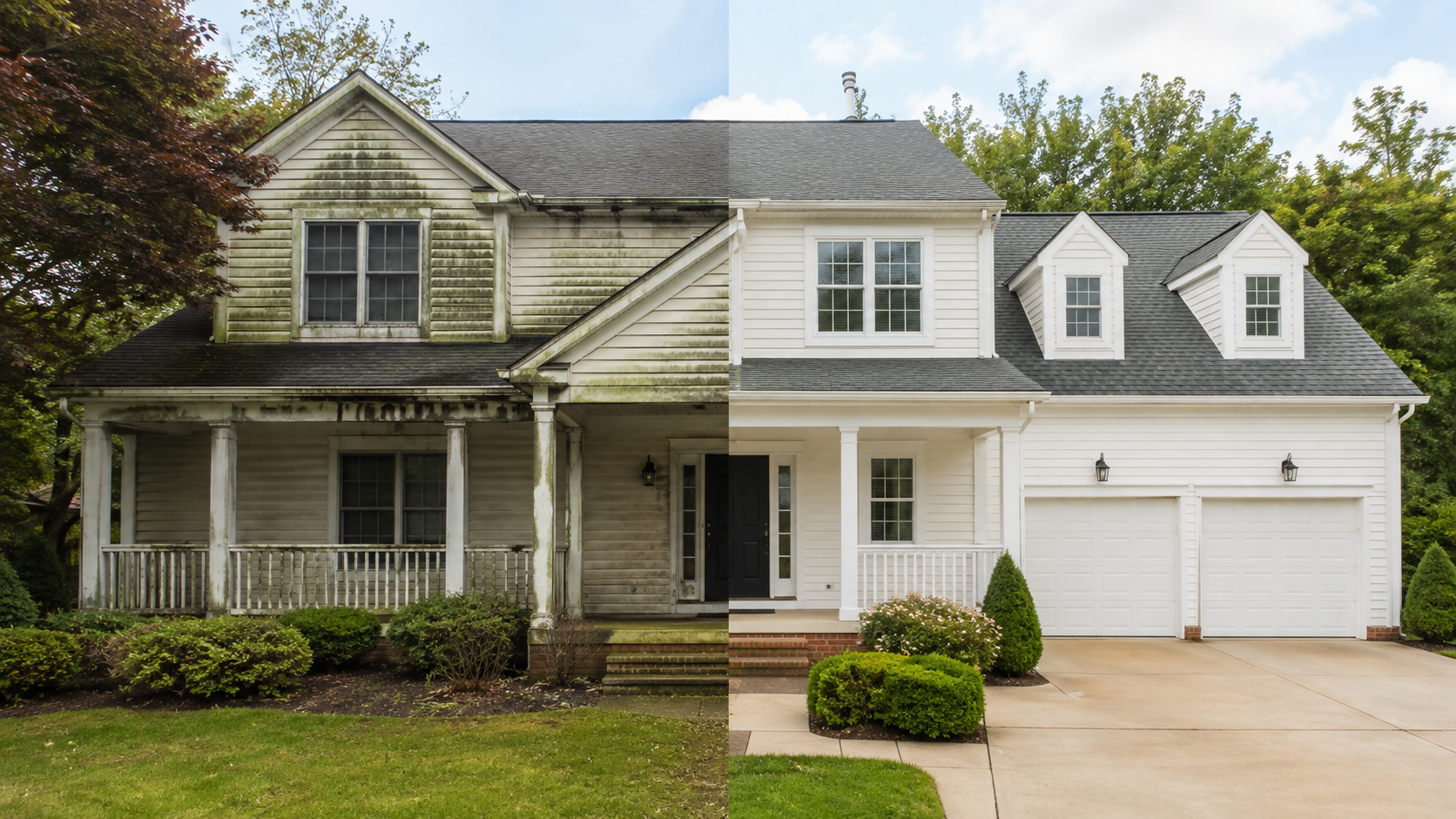
Skipping pressure washing doesn’t just leave a dirty house. Biological growth — algae, mold, mildew — embeds into siding, concrete, and wood surfaces and begins breaking them down over time. Stains become permanent. Algae roots into soft surfaces. Mold spreads to caulk, trim, and eventually into wall cavities in Northern Virginia’s humid climate. The longer you wait, the harder and more expensive the cleaning becomes, and some surface damage from neglect is irreversible.
Year by Year: What Actually Happens
The deterioration from skipping exterior cleaning isn’t dramatic at first. Year one, you notice some green along the lower siding and a bit of pollen haze. Year two, those spots darken and spread. By year three, you’re looking at visible algae colonies, black mold streaking, and stains on the concrete that weren’t there before. By year five, the conversation shifts from cleaning to repair.
| Time without cleaning | What’s happening | Reversible with cleaning? |
|---|---|---|
| Year 1 | Surface pollen, light algae on north walls, general grime | Yes — routine wash |
| Years 2–3 | Algae embedding in siding texture, mold on caulk, darker concrete | Mostly yes — professional wash with biocide treatment |
| Years 3–5 | Algae rooting into wood and soft surfaces, caulk discoloration spreading, stains on concrete hardening | Partial — cleaning restores appearance but some staining remains |
| 5+ years | Surface degradation, mold potentially entering wall joints, concrete etching from biological acids, wood rot at trim | Limited — cleaning helps but some damage is permanent |
What Happens to Siding
Algae and mold don’t just sit on siding — they produce acids that degrade surface coatings over time. On vinyl siding, algae roots into the micro-texture and becomes very difficult to remove after a few seasons. On painted wood and fiber cement, biological growth degrades the paint layer and exposes the substrate to moisture. On any siding, mold at caulk joints and window trim is the first step toward moisture infiltration.
Vinyl siding gets its color from pigment in the PVC compound and a UV-protective layer applied during manufacturing. Algae and mold grow in the micro-texture of the surface. After two or three years without cleaning, the growth embeds in that texture, and removing it requires more than a rinse — it needs a biocide treatment to kill the organism followed by low-pressure washing. Wait longer than that, and some staining from the algae’s pigments becomes permanent.
Painted wood and fiber cement siding face a different problem. The paint coat protects the substrate beneath. When algae and mold grow on the paint surface for several years, they hold moisture against the paint film. That sustained moisture causes the paint to blister, chalk, and peel. Once the paint fails, the substrate is exposed — and moisture starts working on the fiber cement or wood directly. Repainting a full exterior after surface failure costs considerably more than periodic washing would have.
What Happens to Concrete Surfaces
Driveways, patios, and walkways look indestructible, but they’re porous and affected by biological growth over time.
- Algae and moss produce organic acids that slowly etch concrete surfaces. Over several years without cleaning, this creates a rough, pitted texture that’s harder to clean and more prone to retaining future stains.
- Embedded oil stains become progressively harder to lift the longer they sit. After five or more years, the oil migrates deeper into the concrete and some permanent staining often remains even after professional treatment.
- Concrete in Northern Virginia’s climate faces freeze-thaw cycles that exploit any surface weakness. Algae and moss growth retains moisture against the concrete surface. In winter, that moisture expands during freezing, accelerating spalling and cracking at the surface.
- Slip hazards increase: green algae on a wet concrete patio or pool deck is genuinely slippery. This isn’t a cosmetic problem — it’s a safety issue that worsens with time and growth thickness.
What Happens to Wood Surfaces
Decks and wood fences are the most vulnerable surfaces when cleaning is skipped. Wood without a protective sealer or stain absorbs moisture readily. Add biological growth to the equation and you get accelerated decay, gray weathering that goes beyond cosmetic, and eventually rot that requires board replacement rather than cleaning.
An unprotected wood deck in Northern Virginia’s climate weathers noticeably in two years and shows significant gray and darkening in three. That gray coloring is partly UV oxidation and partly embedded biological growth. Cleaning can reverse a significant amount of it — pressure washing removes the gray weathered layer and restores bright wood tone — but only up to a point. After four or five years, the wood cells themselves are damaged at the surface and cleaning won’t restore color or texture fully.
More critically, moss and algae on a wood deck hold moisture against the wood fibers. Where moisture persists, decay follows. Deck boards in heavily shaded areas of Fairfax County that go without cleaning for five or more years often show soft spots by the time a homeowner gets around to addressing it. Those soft spots mean board replacement, not cleaning.
What Happens to Driveways and Concrete Block
Concrete block retaining walls, steps, and foundations share many of the same issues as concrete flat work, but with an added vulnerability: mortar joints. Algae and moss growing in mortar joints hold moisture at the bond between blocks. In freeze-thaw cycles, that moisture expansion stresses the joint and accelerates mortar erosion. Over multiple years without cleaning, what started as a cosmetic problem becomes a structural maintenance issue.
The Cleaning Is Harder and More Expensive the Longer You Wait
This is the practical reason cleaning annually matters: a one-year-old exterior washes easily at standard pressure with minimal chemical treatment. A three-year-old exterior needs pre-treatment and more passes. A five-year-old exterior needs biocide dwell time, possibly a second visit, and may still have staining that doesn’t fully clear.
The cost difference between an annual cleaning and a remediation cleaning after several years of neglect is meaningful. More importantly, some damage from extended neglect — paint failure, wood surface degradation, permanent concrete staining — can’t be reversed by cleaning alone. The repair costs that follow are on a different scale.
If you’re looking at a home that hasn’t been washed in a few years and want to know the visible signs that pressure washing is overdue, that page walks through exactly what to look for on each surface.
Don’t Let Another Season Pass
Diamond Power Washers restores home exteriors, driveways, decks, and concrete across Northern Virginia. Veteran-owned, licensed & insured. Serving Fairfax, Manassas, Woodbridge, Chantilly, and 15+ communities.
Frequently Asked Questions
Can pressure washing fix a home that hasn’t been cleaned in five or more years?
It helps significantly but the results depend on the surface and how much biological growth and staining has embedded. Siding often comes back close to its original appearance with professional biocide treatment and low-pressure washing. Concrete may retain some staining from deeply penetrated oil or years of algae acid etching. Wood surfaces with significant gray weathering or soft spots may need board replacement rather than cleaning. A professional walkthrough gives you an honest picture of what’s recoverable.
How long does algae take to damage vinyl siding?
Surface algae doesn’t damage vinyl itself in a structural sense — vinyl is chemically inert. The problem is the growth embedding in the micro-texture of the siding surface and the biologic pigments leaving permanent staining over time. By year three to four without cleaning, some of that staining doesn’t fully clear even with professional treatment. The bigger concern with algae near vinyl is what it does to caulk at trim and window joints — those organic acids and sustained moisture degrade caulk and create pathways for water infiltration.
Does skipping pressure washing affect my home’s resale value?
Visible biological growth, staining, and gray weathering on a home’s exterior create an immediate negative impression with buyers and in listing photos. A home that hasn’t been washed in years can look far older and more neglected than it actually is. A professional pressure washing before listing is one of the more cost-effective ways to improve first impressions. The cost of the wash is typically a fraction of the negotiating leverage a buyer gains from visible exterior neglect.
What’s the most urgent surface to clean if my home has been neglected?
Wood surfaces — decks and fences — are the most time-sensitive because biological growth on wood accelerates decay. Concrete is durable but becomes harder to clean the longer stains sit. Siding is important for appearance and paint life. If you’re prioritizing, start with any wood decking that shows gray coloring, soft spots, or heavy moss growth, then address siding and concrete.
Can pressure washing fix concrete that has turned green from algae?
Yes, in most cases. Green algae on concrete driveways, patios, and walkways responds well to pressure washing with a surface cleaner attachment. For embedded algae, a biocide pre-treatment — diluted bleach solution, dwelled for 10 to 15 minutes — kills the organism before rinsing, which prevents regrowth from dormant cells. After cleaning, the concrete should look close to its original color, though some shadowing from years of growth may remain in the pores.
How does skipping cleaning affect caulking around windows and doors?
Mold and algae at caulk joints introduce sustained moisture and organic acids that degrade the caulk compound over time. Caulk that would otherwise last 10 to 15 years can fail in five to seven years with biological growth holding moisture against it. Failed caulk around windows and doors is a direct pathway for water infiltration. Keeping siding clean also keeps caulk joints dry, which extends their life considerably.
Does algae on my roof spread to the siding if I don’t clean it?
It can. The black streaks on asphalt roofs are caused by Gloeocapsa magma — a cyanobacteria that travels by spore. Roof algae can spread to siding on the same wall, especially on north-facing elevations where shade and moisture favor growth. If you’re seeing biological growth on both a roof and the upper portion of nearby siding, the roof is often the source. Addressing the roof growth first — through soft wash — slows new colonization on adjacent siding.
Written by the Diamond Power Washers team. Veteran-owned, family-owned, licensed & fully insured in Virginia. We’ve cleaned homes across Northern Virginia that range from one year to fifteen years without professional washing — we see firsthand what the progression of neglect looks like on each surface type.
Last updated September 2026.
Sources: Field observation of surface condition across Northern Virginia homes; manufacturer guidelines for vinyl, fiber cement, and wood siding maintenance; concrete maintenance industry documentation.
or call 703-853-4738