
Deck care timing
How Long Do You Need to Wait Between Deck Cleaning and Staining?
Wait at least 48 to 72 hours after pressure washing before applying stain to a wood deck. In humid Northern Virginia summers, shaded decks or dense pressure-treated lumber often need the full 72 hours or longer. Confirm readiness with a moisture meter, not a visual check — the surface can feel dry while the interior wood still holds too much moisture for stain to penetrate correctly.
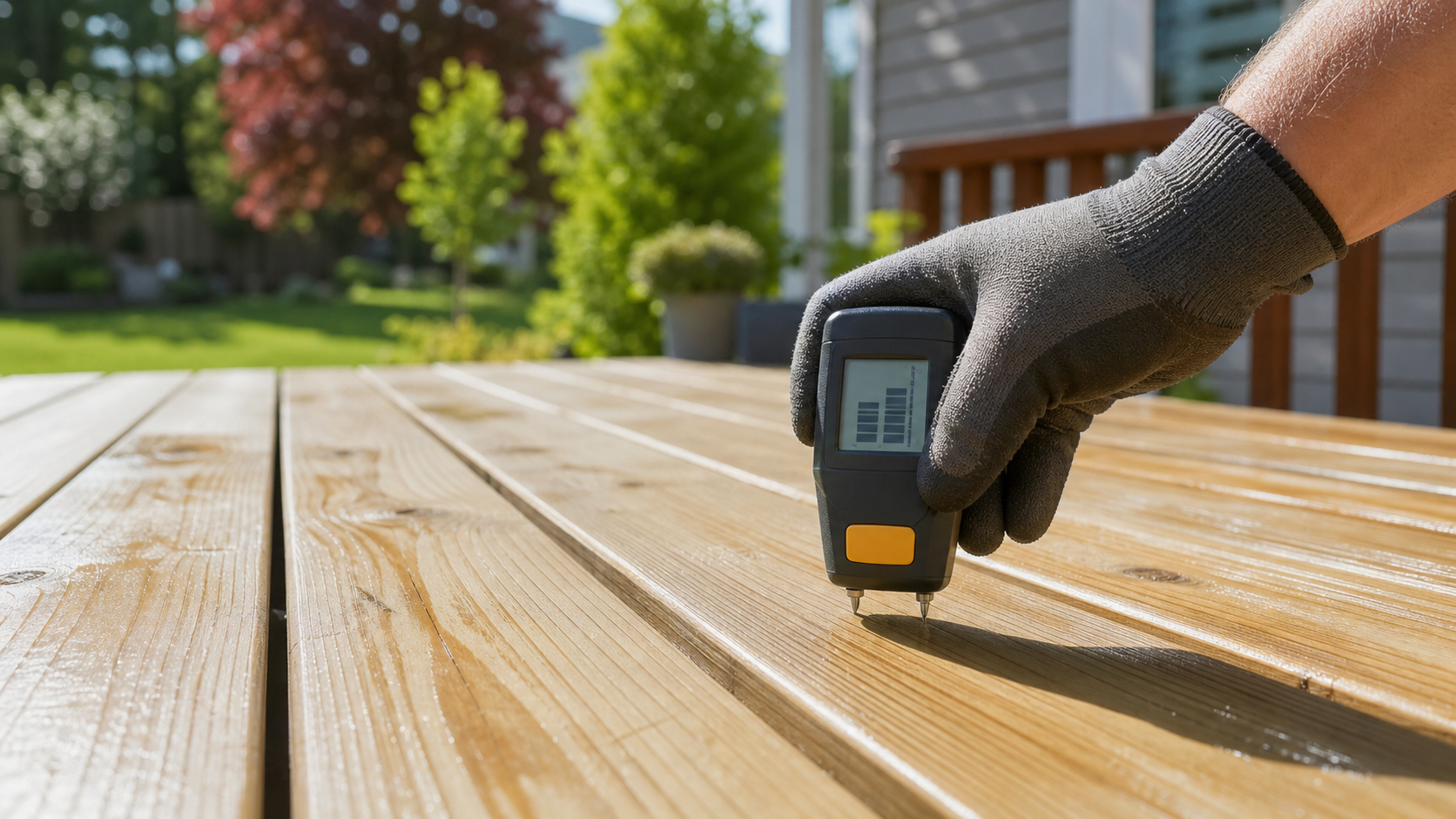
The wait between cleaning and staining is one of those steps that homeowners most often underestimate. It doesn’t look hard. The deck dries out in the sun, it feels dry when you walk on it the next morning — so why wait longer? The short answer: wood holds moisture well below the surface. A deck that’s dry to the touch on a warm afternoon can still carry 25 to 30 percent moisture content two or three inches deep in the boards. Stain applied to wood in that state can’t penetrate properly, and the result fails within a year.
This page breaks down the actual wait times by wood type and weather, how to confirm readiness without guessing, and what happens in Northern Virginia’s summer humidity that makes the clock tick a little differently than in drier climates.
What affects the dry time after washing?
Four things control how long your deck needs to dry: wood species and density, air temperature, relative humidity, and how much direct sunlight the deck gets. Northern Virginia’s combination of summer humidity and shaded suburban lots often pushes dry time to the longer end of the 48 to 72 hour range.
Pressure-treated pine — the material in the overwhelming majority of Northern Virginia decks built after 1990 — is a dense wood that holds moisture well. That quality is part of why it lasts outdoors. It also means it takes longer to release that moisture after a thorough wash. A midday summer wash on a fully sun-exposed PT pine deck in Fairfax County might be stainable at the 48-hour mark. The same deck on a shaded lot in a Reston or Woodbridge neighborhood with mature tree cover could still read too wet at 72 hours.
Relative humidity matters as much as temperature. When the air itself is humid — and Northern Virginia regularly sees 70 to 80 percent relative humidity in July and August — evaporation slows significantly. Even on hot days, the wood releases moisture more slowly than the same temperature in a dry climate like Colorado or Arizona.
Dry time by wood species
Pressure-treated pine needs 48 to 72 hours in summer conditions, longer in fall or shade. Cedar dries faster, typically 48 hours in warm weather. New pressure-treated lumber (recently installed) can need several months to fully dry before first-time staining. Composite decking should not be stained at all.
| Wood type | Summer dry time (NoVA) | Fall / shaded dry time | Notes |
|---|---|---|---|
| Pressure-treated pine (established) | 48 to 72 hours | 5 to 7 days | Most common in NoVA; dense and slow-drying |
| Cedar / redwood | 48 hours | 3 to 5 days | Dries faster than PT; found in older Reston / Ashburn decks |
| Douglas fir | 48 to 72 hours | 5 to 7 days | Dense; similar behavior to PT pine |
| New pressure-treated lumber | Several months | Several months | Factory-saturated; needs to cure before first staining |
| Composite (Trex, TimberTech, etc.) | N/A | N/A | Do not stain; cleaning only |
How to test if your deck is ready to stain
A wood moisture meter is the only reliable test. The target reading is below 15 to 20 percent moisture content, depending on the stain manufacturer’s specification. Press the pins into the wood in several locations across the deck, including shaded spots and north-facing boards, which dry last. Most homeowners can pick up an adequate moisture meter for $20 to $40 at a hardware store.
There’s a simpler field test contractors use when a meter isn’t handy: sprinkle a few drops of water on the deck surface. If the water beads up and sits on top of the wood, the wood is still too wet or has old stain repelling the water. If the water soaks in quickly, the wood is dry enough. This test works as a rough guide but isn’t as reliable as a meter, especially on denser wood species.
Another common test is the “splash and soak” check. Pour a small splash of water on the boards — about a tablespoon. Dry, stain-ready wood absorbs it within a minute. Wood that’s still holding too much internal moisture will let the water sit or absorb very slowly. This check is useful for a quick pass before calling the staining crew, but not a substitute for measurement in critical cases.
What happens if you stain too soon?
Stain applied to wood that’s too wet bonds poorly. Instead of penetrating the grain, it sits as a surface film that peels, flakes, or develops a blotchy, uneven appearance within 6 to 12 months. Repairing a failed stain job requires stripping the old stain off entirely — which is more labor-intensive than the original application — before you can start over.
The failure mode looks different depending on the stain type. Film-forming stains (solid or semi-transparent stains that sit on the surface) peel in sheets. Penetrating stains blotch and turn spotty. Either way, the deck looks worse than it did before the staining, and the repair cost exceeds what would have been saved by waiting an extra day or two.
One of the most common calls we get after a competitor’s job goes wrong is from homeowners whose deck was cleaned and stained on the same day or within 24 hours. The stain looked fine for a few weeks, then started peeling before the first winter. That’s not a stain quality problem — it’s a dry time problem.
Let us handle the timing for you
Diamond Power Washers cleans the deck, waits for the right moisture reading, and returns to stain — no guesswork on your end. We serve Fairfax, Manassas, Woodbridge, Reston, Ashburn, and across Northern Virginia.
Frequently asked questions
How long after pressure washing can I stain my deck?
At least 48 to 72 hours in typical Northern Virginia summer conditions. Shaded decks, dense pressure-treated pine, and decks washed during cooler or more humid weather often need 5 to 7 days. Confirm readiness with a moisture meter reading below 15 to 20 percent rather than relying on how the surface looks or feels.
Can I stain my deck 24 hours after washing it?
In most Northern Virginia conditions, no. Twenty-four hours is not enough for the interior wood fibers to release absorbed moisture from a thorough pressure wash. The surface may look and feel dry, but the deeper grain still holds too much water for stain to penetrate and bond correctly. Staining at 24 hours risks a finish that peels or blotches within 6 to 12 months.
Does weather affect how long I need to wait?
Yes, significantly. High humidity slows evaporation even on hot days, and Northern Virginia summers regularly see 70 to 80 percent relative humidity. Overcast or rainy weather after washing extends the dry time further. Fall temperatures slow drying noticeably — a deck that takes 48 hours to dry in July may take 5 to 7 days to reach stainable moisture levels in October.
What moisture content does wood need to be before staining?
Most deck stain manufacturers specify that wood moisture content should be below 15 to 20 percent before application. Some premium penetrating stains are more permissive and can be applied up to 20 or 25 percent, but 15 percent is a safe universal target. A wood moisture meter, available at hardware stores for $20 to $40, gives you a direct reading.
How can I tell if my deck is dry enough to stain without a meter?
The water drop test: sprinkle a few drops of water on the boards. If they absorb into the wood within 60 seconds, the wood is dry enough. If the water beads up and sits on the surface, the wood is either too wet or has old stain that’s repelling the water. This test works as a rough guide, but a moisture meter is more reliable, especially for dense pressure-treated lumber.
Does the type of wood stain change how long I need to wait?
Slightly. Some penetrating stains are formulated to work in wetter conditions, with moisture tolerance up to 20 to 25 percent. Solid stains that form a surface film generally require the driest conditions. Always check the manufacturer’s specification for the specific product being used. If you’re unsure, 15 percent moisture content is a safe target for any stain type.
How long should I wait to stain a brand-new deck?
New pressure-treated lumber arrives from the mill heavily saturated with preservative treatment and needs several months to dry before staining. Staining a new deck too soon is one of the most common mistakes homeowners make. The industry standard recommendation is to wait at least 6 months and often a full year before staining new PT pine in Northern Virginia’s climate.
What is the best time of year to stain a deck in Northern Virginia?
Late spring and early fall offer the most reliable conditions: temperatures between 50 and 90 degrees Fahrenheit, moderate humidity, and no frost risk. May and September are the most popular months for deck staining in Fairfax County and Prince William County. Midsummer can work for sun-exposed decks, but avoid staining on days above 90 degrees, which causes the stain to dry too fast on the surface before it penetrates the wood.
or call 703-853-4738