
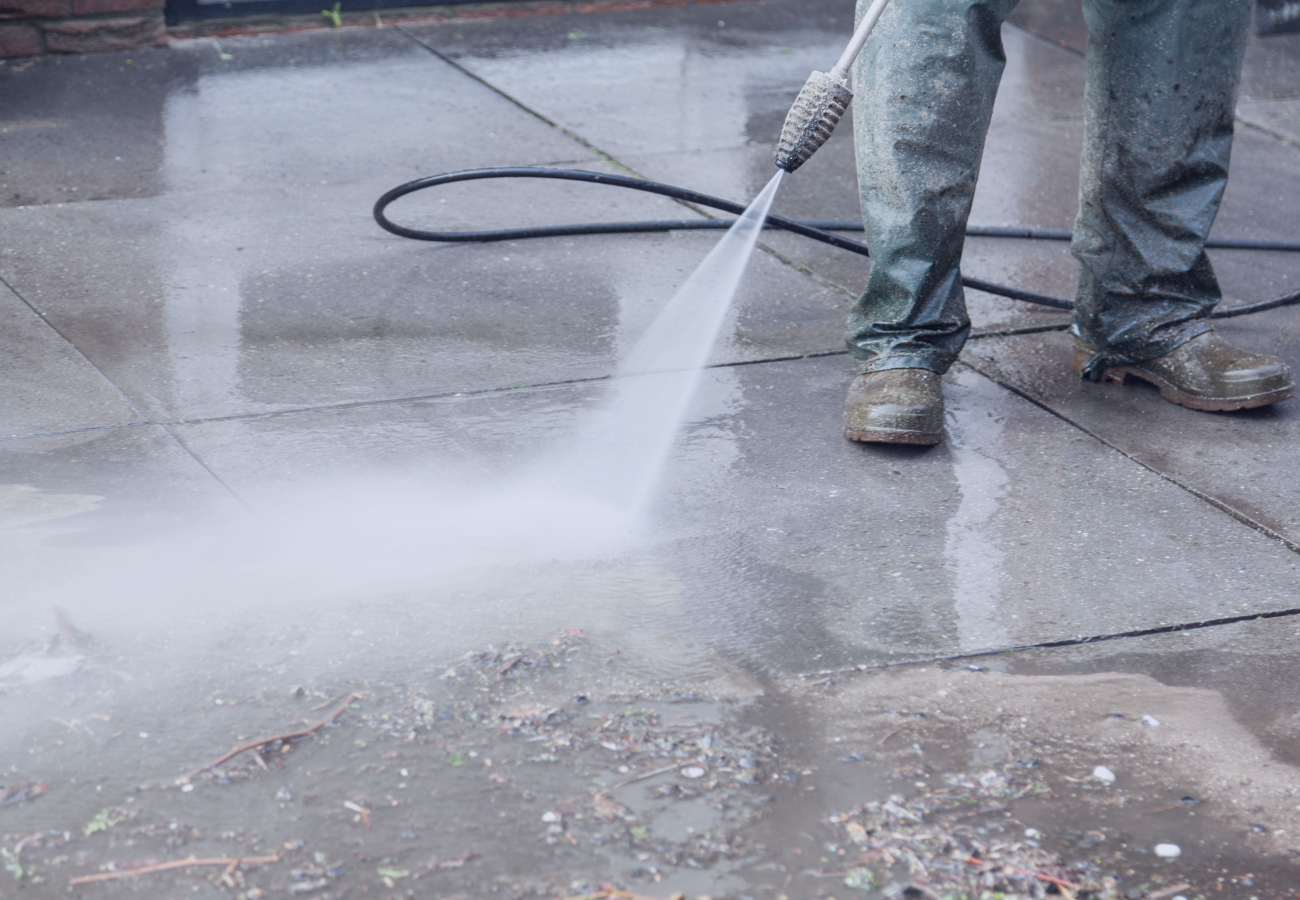
Why Concrete in Woodbridge Gets Dirty So Quickly
- Algae and mildew grow in high humidity and shade (hello, slippery sidewalks).
- Brown ghost stains are left behind by leaf tannins and fertilizer.
- Oil and transmission fluid seep into the pores.
- Rust grows near hose bibs, irrigation, and garages.
- The white film (efflorescence) is caused by winter de-icing salts and water moving around.
- Dust, pollen, and soot from cars make a dull gray haze.
What’s going on:
Concrete is like a very hard sponge in that it has holes in it. Not only do pollutants sit on top, they also soak in. The microclimate around Lake Ridge, Dale City, Occoquan, Montclair, Belmont Bay, Marumsco, and the Potomac Mills corridor is great for growing things. Algae film and mildew love to grow on walkways that face north, drives that are covered in trees, and low spots that stay wet. You can add oil spots from driving to work every day, orange rust around irrigation overspray, and winter salts that have been tracked from I-95. These are stains that a garden hose won’t be able to get rid of. That’s why “more PSI” isn’t as important as a controlled process that includes pretreatment, even-pressure cleaning, and post-treatment.
What works and what doesn’t when you do it yourself
- It’s fine to do it yourself if there’s only a little dust and pollen.
- Tiger striping and etching with too much pressure are the biggest risks.
- Using the wrong chemicals can leave stains or kill plants.
- Pros bring surface cleaners, higher GPM, hot water, and chemicals that work on specific problems.
Let’s take it apart:
It’s fine to rent a pressure washer and use it for a light rinse. Things go wrong when you try to blast oil or rust out with a wand. A narrow tip up close will leave “tiger stripes,” which are the permanent lines you see on DIY driveways, or it will scar the paste layer. Also, not all stains can be cleaned with the same cleaner. Some rust removers that work on brick may change the color of concrete. Some generic degreasers can push oil deeper without first breaking it up. Professional power washers use commercial surface cleaners (to make sure there are no swirls), higher water flow (GPM) to move dirt without putting too much pressure on it, hot water to get rid of oil stains, and a biodegradable chemical playbook that works on each stain at the right concentration. The end result is cleaner concrete with less risk.
How to Clean a Concrete Driveway in Woodbridge, VA from Start to Finish
- Pretreat by type of stain (oil, organic, rust).
- For even results, use a commercial surface cleaner.
- Put hot water on oil and gum that are deep.
- After treatment, even out the color and slow down hair growth.
- Take care of runoff to keep landscaping and storm drains safe.
How we do it at Diamond Power Washers, step by step:
We start by walking around to look for oil halos, algae streaks, rust blooms, efflorescence, and drainage patterns. Plants are watered and protected ahead of time, and outlets are covered. Next, stains are treated before cleaning. For oil stains, use a degreaser or enzyme; for algae or mildew stains, use an organic cleaner; and for orange marks, use a rust remover. After the right amount of time has passed, we switch to a surface cleaner that makes consistent, overlapping passes without leaving “zebra” stripes. When we have a lot of oil or gum, we add hot water to break the surface tension. This makes the contaminants let go instead of spreading. We finish with a light post-treatment that evens out the color and stops fast regrowth in shady areas. Then we rinse in a smart way, sending water away from beds and storm drains. The reward is a bright, even slab that dries quickly and stays cleaner for longer.
Stain-by-Stain Game Plan: What Works and What Doesn’t
- Oil and grease: treat first and then heat to release deeply; old stains may leave a shadow.
- Rust and fertilizer: special removers usually get rid of it, but acid burns can leave scars.
- Algae and mildew: cleans up well, but the shade may need to be touched up every now and then.
- The right mix will make leaf tannins much lighter.
- Efflorescence: get rid of it and neutralize it; drainage fixes work for a long time.
- Tire marks and gum: heat and soap work quickly.
Things that set expectations:
Oil and grease: Degreasers that have enzymes or solvents in them break bonds so that hot water can lift oil. You should see a big difference on older, baked-in spots, but there may still be a faint “ghost” because the oil went deeper years ago. Sealing afterward makes it harder for the next spill to happen.
Oxalic and citric acid mixes are gentle on concrete and tough on orange stains. The color can get a lot better if the rust came from battery acid and the surface was etched, but the etched texture won’t “heal” without resurfacing.
Mildew and algae: The concrete looks brand new after being rinsed. A light post-treatment in shady, wet areas gives you more time before the green film comes back.
Leaf tannins: The tea-colored spots on maples and oaks can be cleaned with specific cleaners. Very old stains on unsealed slabs can leave a slight cast that is hard to see after a full clean.
Efflorescence: We get rid of the mineral crust and make it neutral. If water wicks up from below because of problems with drainage or downspouts, it can come back later. It’s easy to get rid of, and we’ll show you how to do it.
Tire marks and gum: Warm water and the right detergent get rid of them quickly without damaging the surface.
How often should you clean concrete in Woodbridge, and when is the best time?
- Most homes: once a year.
- Every 6 to 9 months, if there is a lot of shade, traffic, or sprinklers.
- Best times are late spring (after pollen) or early fall (before leaves fall).
- Cleaning after winter gets rid of dirt and salt.
What to look out for:
If your walkway is still slippery after a light rain, algae and mildew are back. If you see oil halos or orange streaks near the hose bib on the driveway, make an appointment to have it cleaned before the stains get worse. A lot of people who live in Woodbridge want to have their patios and pool decks cleaned in late spring, after the pollen has settled. Early fall is also a good time to do it because your concrete will be clean when winter comes, with less organic debris that would otherwise trap moisture. A post-winter rinse and clean helps get rid of scaling and that chalky white film if you used de-icing salts.
When it makes sense to seal after cleaning
- Sealing keeps oil from getting in, slows down algae growth, and helps with freeze-thaw.
- For a natural look on broom-finished slabs, use penetrating silane or siloxane.
- For stamped or colored concrete, use the right decorative sealer.
- Apply after cleaning and letting it dry completely. Don’t let moisture get trapped.
A little bit of information goes a long way:
Sealing isn’t required, but it protects your cleaning investment, especially on older concrete that is more porous. Penetrating silane/siloxane sealers soak into the slab, keep water and de-icers out, and let the slab breathe. The driveway still looks like concrete because they don’t leave a plastic sheen. A compatible decorative sealer can make stamped or colored surfaces look deeper and add a little shine. We also make sure that wet areas don’t feel like ice by matching slip resistance. Timing is important: we let the slab dry for the right amount of time (usually 24 to 48 hours, depending on the weather) and check the moisture level so that nothing gets stuck below the sealer.
Safety for people, pets, plants, and the area around them
- Using biodegradable detergents the right way.
- Plants are first wet, then protected, and finally rinsed.
- Runoff control stops dirty water from getting into storm drains.
- Changed the pressure around joints, edges, and pavers to keep them from breaking.
This is important because:
Cleaning concrete shouldn’t hurt your landscaping or the waterways in your area. When we clean, we make sure to wet down shrubs and grass so that the leaves don’t attract cleaner. We also use the right dilution rates and send the rinse water where it needs to go. The pressure and distance change around expansion joints, garage doors, and paver edges so that nothing chips or blows out. We give you extra protection and a second rinse after the first one for peace of mind if you have koi ponds, rare perennials, new sod, or sensitive beds.
Cleaning Concrete for Businesses in Woodbridge and Prince William County
- Gum, spills, and dirty traffic on sidewalks and storefronts.
- Clean, deodorize, and degrease dumpster pads and loading zones.
- Restaurants and cafes: clean up the grease track and the patio.
- Gas stations: oil sheen and pump island detail.
- HOAs and multifamily buildings have the same sidewalks, mailboxes, and pool decks.
What we do about it:
Cleaning the concrete around a business makes the whole property look better. Customers can tell when the way is bright and safe versus patchy and slick. We make sure to keep up with regular maintenance so you don’t have to rush around before inspections or board meetings. Hot-water cleaning helps break down buildup quickly on greasy pads and in restaurant areas. We can come by when it’s not busy to avoid bothering people, and we can take pictures before and after the work for records, HOA boards, and insurance purposes. There is a lot of awareness about stormwater, especially around drains and curbs.
What affects prices (so you can plan without having to guess)
- The number of areas (driveway, walkways, patio, pool deck) and the square footage.
- Types of soil load and stains include oil, rust, organics, and efflorescence.
- Need for hot water or special care.
- Accessibility (hose reach, slopes, and tight side yards).
- Business needs (after-hours, water recovery, paperwork).
How to get a quick and correct quote:
Take three to five pictures from different angles and give rough measurements. Tell us about any places that have oil, rust, or a white film on them, and if you’ve tried any store-bought products (so we know what’s already on the surface). Most homeowners think that hiring a professional to clean is much cheaper than replacing or resurfacing, and the visual upgrade happens right away.
Areas We Serve Every Week
- Woodbridge, Lake Ridge, Dale City, Occoquan, Montclair, Marumsco, Featherstone, and Belmont Bay
- Communities close by in Prince William County
Why this is important: Having experience in the area helps. We know which neighborhoods have a lot of shade, where irrigation overspray happens a lot, and how pollen falls in different streets at different times of the year. We might already be working a few blocks away when you call.
Questions about cleaning concrete that people in Woodbridge often ask
How can I best clean a concrete driveway in Woodbridge, VA?
Clean with a surface cleaner, use hot water for oil, and finish with a light post-treat.
Start with pretreatment to get the stains out of the pores. A surface cleaner makes even, overlapping passes that don’t leave wand marks. Without raising the PSI, hot water helps break down oils. A post-treatment makes the color more even and slows down the growth of algae, especially in the shade.
Is it possible for pressure washing to hurt my concrete?
If the PSI is too high and too close, it can etch or stripe. Use high GPM and controlled pressure.
Yes, damage does happen when a wand is held close with a narrow tip. To keep the finish even and protect the paste layer on top, we use the right tip angle, distance, and a cleaner for the surface.
Do you wash concrete with soft water?
Yes, for stamped or colored concrete, use lower pressure and detergents. A standard broom finish works best with a surface cleaner and controlled pressure.
Lower pressure, targeted chemistry, and careful rinsing are good for decorative surfaces. For normal driveways, the safest way to clean them is to use even-pressure passes with the right flow rate.
When can I park on it?
Walk in about an hour; drive in a few hours, depending on the weather.
The time it takes to dry depends on the temperature and humidity. At the end of service, we’ll give you a quick window so you don’t have to guess.
Can you get rid of rust and fertilizer stains completely?
Yes, but battery acid etching can leave changes in texture.
Most orange stains come off with our rust removers. We can make the color much better, but we can’t replace the missing paste without resurfacing.
What about that green, slippery film that covers sidewalks in the shade?
That’s algae or mildew; it cleans up well and takes longer to come back after treatment.
You’ll notice the difference right away. If we add a light post-treat, you can expect longer gaps between full cleanings in areas with a lot of shade or near downspouts.
Why does a white powder keep coming back after it rains?
Efflorescence is caused by mineral salts. Cleaning and neutralizing help, but drainage fixes are even better.
We take off the crust and make the surface neutral. If groundwater or rainwater keeps getting under the slab, it can happen again. Redirecting water makes the clean look last longer.
Should I put a seal on the driveway?
Silane/siloxane that penetrates helps keep water, salt, and oil out.
Sealing makes your driveway look better between cleanings and makes it easier to clean up spots. We’ll suggest the best product for your concrete and how you plan to use it.
Simple things to do between professional cleanings
- Quickly blot the oil; don’t hose it deeper.
- After applying fertilizer or when a lot of leaves fall, rinse.
- Cut back shrubs to let more air flow in shady areas.
- Don’t let the gutters and downspouts dump on the slab.
- Put mats or drip trays under places where you know there are leaks.
Why they are useful:
You don’t have to pay attention to concrete every day, but these small things will keep stains from setting. If you blot the oil, it won’t spread. A quick rinse after fertilizing or a storm that drops a lot of leaves keeps tannins from getting stuck. Better airflow dries shaded strips faster, which makes it harder for algae to grow. And moving downspouts away from the driveway makes efflorescence and slippery spots less likely.
Are you ready for concrete that looks new again?
When you look for “concrete driveway cleaning in Woodbridge, VA,” you want two things: a driveway that looks great and a process that won’t hurt your property. That’s what we promise: results that don’t leave streaks, honest stain expectations, polite runoff control, and clear communication. Send us a few pictures and tell us what you want cleaned (the driveway, sidewalks, patio, and pool deck), and we’ll send you a clear, itemized quote.